Nerve damage appearing symmetrically in the toes and fingertips, then extending upward along both limbs, defines glove and stocking neuropathy. Its symmetric nature distinguishes this condition from a singular pinched nerve or a stroke. Most instances stem from identifiable and treatable origins: diabetes, a vitamin B12 deficiency, alcohol consumption, or chemotherapy. However, the opportunity to reverse nerve damage disappears once the actual nerve fibers, or axons, are destroyed, rather than just their protective insulating sheath.
Most cases progress gradually, over many months. Seek immediate emergency medical care if any of the following arise:
Quickly worsening weakness that ascends suggests Guillain-Barré syndrome, an acute inflammatory disorder that can lead to respiratory failure. This condition requires prompt attention and does not allow for a scheduled outpatient visit.
Saddle area numbness alongside leg symptoms indicates spinal cord involvement, not merely a peripheral nerve condition. This specific combination requires urgent imaging on the same day.
Peripheral nerve fibers do not receive nutrients at every point along their structure. The nerve cell body, situated near the spine, transports energy down the entire axon to its farthest tip. The more extended the fiber, the more challenging this transport task becomes.
When an overall bodily problem disrupts this nutrient supply, the farthest parts of the longest fibers are the first to fail. This means the toes are affected before the ankle. The ankle shows symptoms before the knee. Fingers are impacted later, once the damage reaches the shorter upper-limb fibers.
A single area of numbness on one shin results from an entirely different mechanism.
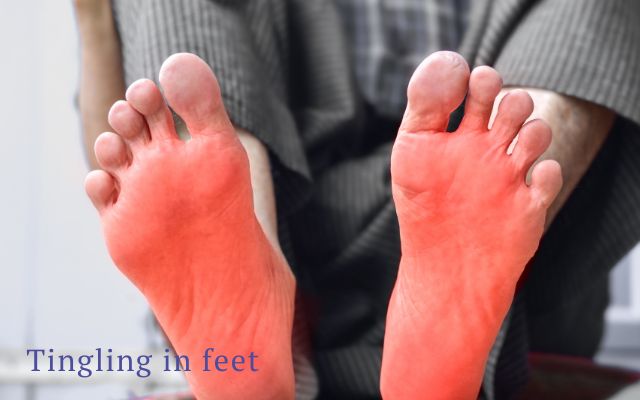
Fibers with a small diameter transmit pain and temperature signals. These typically fail before larger-diameter fibers, which carry vibrations and information about limb position. Burning sensations and tingling generally precede issues with balance.
A patient experiencing burning feet who still passes a tuning fork test may have considerable small-fiber loss. Standard nerve conduction studies will not detect this. For this reason, additional diagnostic tests exist.
Diabetic peripheral neuropathy represents the most frequent cause in the United States. Persistently high blood sugar harms the myelin sheath and, over time, the axon itself. Symptoms might appear even before a formal diabetes diagnosis, particularly in individuals with elevated fasting glucose levels.
A lack of B12 causes a decline in vibration sense and proprioception. Unsteadiness frequently presents before numbness. While serum B12 levels can appear normal, an active deficiency might still be present, making methylmalonic acid and homocysteine levels more dependable indicators. Copper deficiency causes an almost identical presentation and is often missed when B12 results are borderline.
Alcohol-related neuropathy involves direct nerve toxicity combined with a secondary B1 (thiamine) deficiency. The burning, painful presentation is more pronounced than in cases related to diabetes. Chemotherapy agents, specifically taxanes and platinum compounds, are well-known to cause a glove and stocking pattern. Damage can persist for weeks following the final dose, a phenomenon known as coasting.
Hypothyroidism, kidney disease, and paraprotein disorders each result in length-dependent neuropathy. A comprehensive neuropathy blood panel includes checks for thyroid function, a complete metabolic panel, serum protein electrophoresis, and markers of inflammation. If all standard tests yield negative results, genetic testing for hereditary neuropathies becomes relevant, especially for patients with a family history of foot deformities or early problems with balance.
Early on, tingling or pins and needles appear at the toes and the ball of the foot. Patients often describe it as wearing thin socks when barefoot, or feet that feel slightly asleep but never fully wake up. These symptoms are intermittent at first.
Numbness becomes constant and moves up the legs as the condition progresses. Burning pain at night is common when small fibers are heavily involved. Balance problems appear when the ankle loses reliable signal from the foot.
Write down when you first noticed something, not when it started bothering you enough to mention it. Those two dates are usually months apart, and the first one is the clinically useful one.
Weakness in the foot muscles, hammer toe deformity, and difficulty with fine motor tasks in the hands signal motor fiber involvement. A foot ulcer in a patient with established neuropathy is also urgent. Loss of protective sensation allows tissue injury to go unnoticed until infection is advanced.

Nerve conduction studies measure the speed and strength of electrical signals passing through large myelinated fibers. Reduced velocity points towards demyelination. Decreased amplitude suggests axon loss. EMG assesses the muscle's electrical activity at rest and during contraction, differentiating nerve damage from primary muscle disease.
Standard nerve conduction studies completely miss small-fiber neuropathy. Small fibers are too thin to be measured using surface electrodes. Autonomic function testing, including sudomotor (sweat gland) testing, and skin punch biopsy to assess intraepidermal nerve fiber density, detect what electrodiagnostics cannot.
A full neuropathy blood panel is performed concurrently with nerve testing: fasting glucose, HbA1c, B12, methylmalonic acid, copper, thyroid function, a comprehensive metabolic panel, and serum protein electrophoresis.
Demyelinating neuropathy, where the insulating sheath is damaged but the axon remains intact, may recover once the root cause is removed. Remyelination occurs over weeks to a few months in situations like a corrected B12 deficiency.
Axonal neuropathy recovers more slowly. Nerves regrow at approximately 1 to 3 millimeters per day. A nerve injured at the knee might require nearly a year to reach the foot, if the cell body survived at all. When axon loss is extensive and the cell body is gone, recovery will not occur.
Delaying treatment for a correctable metabolic cause does not halt the damage. It converts potentially reversible demyelination into irreversible axon loss.
Treatment targets two things: the underlying cause and the symptom burden. Treating only pain without finding the cause allows nerve damage to continue.
Cause-directed treatment includes:
Stabilization is a realistic goal. Full reversal of established axon loss is not.
For neuropathic pain, common options include:
Physical therapy addresses balance deficits and reduces fall risk. Foot care protocols reduce ulcer risk when sensation is impaired. Balance failure from large-fiber neuropathy causes falls, and falls cause fractures.
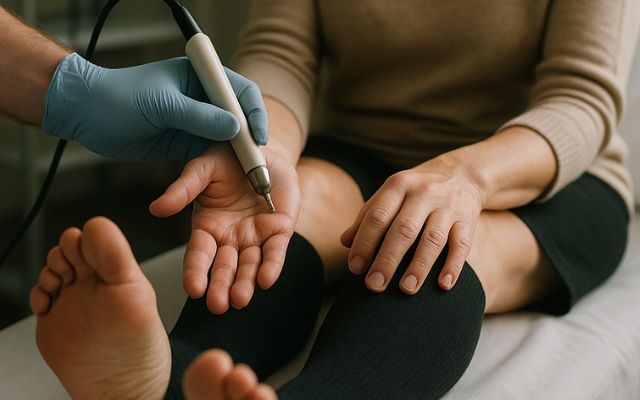
Bilateral carpal tunnel and bilateral tarsal tunnel syndrome can cause hand and foot numbness that resembles the glove and stocking distribution. The distinction lies in focal compression at specific anatomical sites, rather than length-dependent fiber failure. Nerve conduction studies at these sites reveal focal slowing instead of diffuse distal changes.
Myelopathy refers to spinal cord disease. It produces limb numbness and weakness but follows a different anatomical arrangement. Brisk reflexes and a positive Babinski response differentiate myelopathy from peripheral neuropathy. A patient with apparent distal sensory loss and brisk reflexes requires spinal imaging before the investigation concentrates on peripheral nerves.
Patients who regain meaningful function are those evaluated before EMG results show widespread denervation. Waiting until symptoms clearly interfere with daily activities frequently means waiting past the phase where reversal is possible.
Universal Neurological Care conducts nerve conduction studies and autonomic testing on-site in Jacksonville. The complete diagnostic picture becomes available during the same visit, avoiding multiple referrals. This evaluation identifies which fiber types are affected, determines the likely cause, and guides which blood tests are genuinely necessary.
If you have experienced tingling or numbness in both feet for more than a few weeks, or if burning pain disrupts your sleep, arrange your consultation today.
Yes. B12 deficiency, alcohol consumption, chemotherapy, hypothyroidism, kidney disease, and paraprotein disorders all produce the same length-dependent pattern. A full neuropathy blood panel is essential because treatment varies entirely by cause. Managing pain without identifying the underlying driver allows nerve damage to persist.
No. Standard nerve conduction studies cannot measure small fibers because they are too thin for surface electrodes. Autonomic testing, including sudomotor function tests, and skin punch biopsy for intraepidermal nerve fiber density, represent the appropriate next diagnostic steps. Many patients receive a normal nerve conduction result and conclude nothing is wrong, when small-fiber loss is already significant.
Demyelinating neuropathy resulting from a corrected nutritional deficiency might improve within weeks to a few months. Axonal neuropathy recovers at approximately 1 to 3 millimeters daily, so noticeable improvement in foot symptoms after an injury at knee level can require nearly a year. If the underlying cause remains uncontrolled, recovery will not commence regardless of the time elapsed.
No. Both conditions reflect the same underlying process affecting different fiber types. Burning pain originates from small-fiber involvement, specifically the fibers transmitting pain and temperature signals. Numbness reflects large-fiber loss, impacting vibration and proprioception. A neurologist assesses all three sensory domains rather than merely addressing the most prominent complaint.