A tingling feeling in the face can last thirty seconds or persist for weeks, and that difference tells a neurologist more than the sensation itself.
Patients describe it as pins and needles, as a patch of cheek gone half-asleep, or as something crawling along the jawline. Descriptions vary widely, and most cases turn out to be harmless.
Not all of them are. Facial sensation travels on a nerve that originates in the brainstem, which is why the same symptom can follow a routine dental injection or signal a stroke.
What follows is how those causes get separated. The first question a neurologist asks is not what the tingling feels like, but where on the face it sits.
Where the tingling sits narrows the list before anyone orders a test. According to the National Institute of Neurological Disorders and Stroke, the trigeminal nerves are "a pair of cranial nerves that connect the brain and brain stem to different parts of the face." The nerve splits into three branches, and each branch covers a specific strip.
| Branch | What it covers | Commonly affected by |
|---|---|---|
| Ophthalmic (upper) | Scalp, forehead, front of the head, around the eye | Shingles, sinus disease, demyelinating lesions |
| Maxillary (middle) | Cheek, upper jaw, top lip, upper teeth and gums, side of the nose | Dental work, sinus infection, facial trauma |
| Mandibular (lower) | Lower jaw, lower teeth and gums, bottom lip, chin | Wisdom tooth extraction, dental implants, jaw injury |
A tingle that respects a border, stopping cleanly at the cheekbone or along the jawline, points to that branch. One that ignores anatomy and covers half the face without regard for where the branches divide points somewhere higher up.
Three details separate a nuisance from an emergency.
One side suggests something structural: pressure on a nerve, a lesion, an injury, a vascular event. Both sides at once usually means something systemic reached both nerves simultaneously, which is what happens with vitamin deficiency, low calcium, thyroid disease, or a drug side effect. Symmetry is generally the more reassuring answer.
Face and hand tingling together, on one side, with nothing in between, is a recognized pattern called cheiro-oral syndrome. The lips and the hand sit right next to each other on the brain's sensory map, even though they're nowhere near each other on your body, so a small lesion along the sensory pathway, most commonly in the pons or thalamus, can knock out both while sparing the arm entirely.
Case reports link the pattern to thalamic stroke and hemorrhage. That combination earns a same-day evaluation, not a wait-and-see.
Seconds to minutes suggests a vascular cause or a seizure. Hours to days fits inflammation, infection, or a post-viral process. Weeks to months fits compression, demyelinating disease, or a slow-growing lesion. Write the date down. It does more work in the exam room than your description of the sensation will.
Facial tingling comes from four broad places, and what to do about it depends entirely on which one.
Trigeminal neuralgia produces sudden shock-like pain on one side, with burning, numbness, or dull aching between attacks. NINDS notes secondary cases can stem from multiple sclerosis, a tumor, or an arteriovenous malformation.
Dental procedures are another route entirely: wisdom tooth extraction and implant placement can come close enough to bruise or compress the nerves that feed the lower lip and tongue.
Stroke, TIA, multiple sclerosis, and tumors all produce facial sensory changes. MS is worth mentioning specifically because facial numbness is a common early presentation in younger adults, often alongside double vision or a bout of blurred vision in one eye.
B12 deficiency, poorly controlled diabetes, thyroid disease, and low calcium or magnesium all produce nerve related symptoms that can reach the face. So do certain medications, including some chemotherapy agents and long-term metformin. Blood work sorts these out quickly and cheaply, which is why it usually comes first.
A migraine aura can cause a tingle to slowly march across the face over five to sixty minutes, often continuing into the same-side hand, then fading. A headache may or may not follow.
Rapid breathing does something different. Fast shallow breaths drop blood carbon dioxide, which lowers blood calcium levels and makes nerves fire more easily, producing a tingle around the mouth and in both hands within minutes.
Symmetric, brief, tied to panic or acute anxiety. That mechanism is worth understanding, because "it's just anxiety" is only a safe conclusion after the one-sided causes have been ruled out.
Sudden onset plus any other neurological change means call 911.
Many stroke centers use B.E.F.A.S.T.: balance loss, eye or vision changes, face drooping, arm weakness, speech difficulty, and time to call 911. Their guidance also lists numbness or weakness of the face, arm, or leg, especially on one side of the body.
Check the clock when symptoms start, and call 911 even if they go away on their own, because a TIA that resolves still carries a high short-term stroke risk.
Short of 911, get seen the same day for the following:

The exam maps the territory, then imaging and nerve testing confirm what the map suggested.
A neurologist tests light touch and pinprick separately across all three branches, checks the corneal reflex, and tests jaw muscle strength. A deficit that follows one branch means the problem sits in the nerve. A deficit that covers half the face and ignores branch borders means it sits higher up.
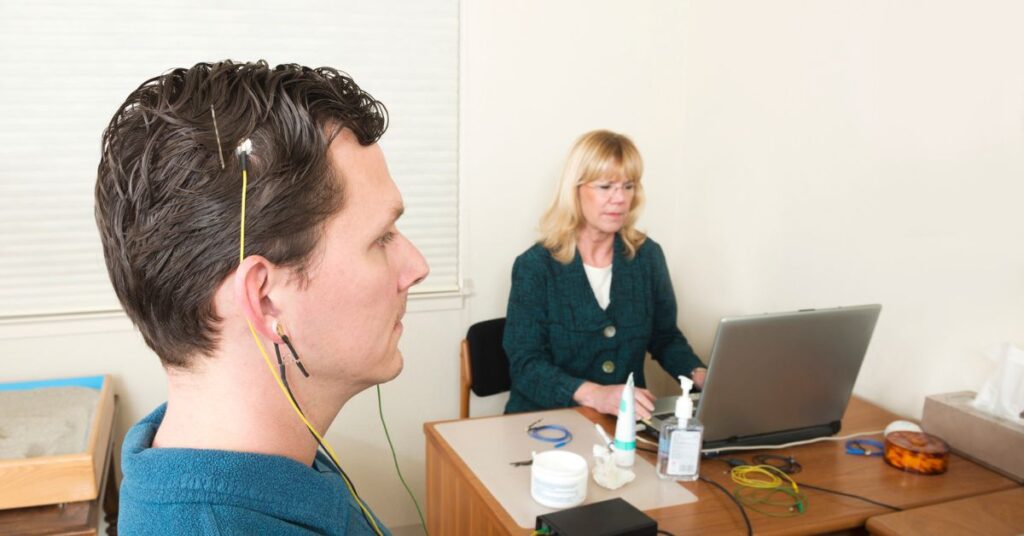
Brain MRI looks for stroke, demyelinating lesions, and structural causes. Evoked response testing measures how quickly signals travel along sensory pathways and can detect demyelination that imaging misses. Blood work covers B12, glucose, thyroid, and inflammatory markers.
Universal Neurological Care runs all of it through its neurology services in Jacksonville, which keeps the workup under one roof rather than spread across three appointments.
Facial tingling that comes and goes for a week deserves an appointment. Facial tingling that arrives suddenly alongside weakness, droop, slurred speech, or a vision change deserves a 911 call tonight.
Most cases turn out to be treatable: a vitamin level to correct, a medication to swap, or a nerve recovering from dental work on its own schedule. Most people get checked expecting one answer and leave having ruled out two others, and that second part is the useful one.
Universal Neurological Care maps facial sensory symptoms branch by branch, then confirms the cause with brain imaging, evoked response testing, and bloodwork ordered inside the same visit. Our neurologists separate the peripheral causes from the central ones quickly, which is what determines whether you need a prescription, a scan, or emergency care.
Book an appointment today with our Jacksonville team.
Yes, through over-breathing. Rapid shallow breathing lowers blood carbon dioxide, which makes nerves fire more easily and produces tingling around the mouth and across both hands. It's symmetric, and it settles once breathing normalizes. Anxiety is a reasonable explanation only after the one-sided causes have been excluded.
Injections and extractions sit close to two specific nerves: the inferior alveolar, which supplies the lower lip and chin, and the lingual, which supplies the tongue. Bruised or stretched nerves produce tingling that usually fades over six to eight weeks. Numbness still present at three months should be evaluated, since spontaneous recovery drops off sharply past that point and the window for surgical repair is limited.
It can be. Facial sensory symptoms are a recognized early presentation, particularly in adults aged 20 to 40, and often occur alongside optic neuritis or double vision. One episode on its own isn't a diagnosis. Diagnosis requires evidence of damage in more than one part of the central nervous system, occurring at more than one point in time, which is why a single bout of facial tingling gets an MRI rather than a label.